Provision an AKS Cluster - How to
On this page you will learn how to setup an edge system with an Azure Kubernetes Service (AKS) cluster using the cluster installation tools in the Kelvin UI.
If you want Kelvin to be responsible to also install the Kubernetes cluster directly and handle all the management of the cluster, you can choose the K3S option.
Amazon Kubernetes Service (AKS)

Amazon Elastic Kubernetes Service (Amazon AKS) is a fully-managed service that simplifies the deployment and management of Kubernetes clusters. It provides a highly available and scalable platform to deploy containerized Applications using Kubernetes, without the need to manage the underlying infrastructure.
Requirements & Limitations
Cloud Kubernetes implementations vary across providers, and even within the same provider, there can be different types of stacks based on the selected services.
So it is not possible to list all the requirements, limitations and fixed design options available and will heavily depend on your project and budgets.
When setting up your cluster on AKS here are some links to the AKS documentation that can help you decide what type of setup to implement.
- Kubernetes core concepts for Azure Kubernetes Service
- Azure Well-Architected Framework review
- Quotas, virtual machine size restrictions, and region availability
- Azure Kubernetes Service (AKS) architecture design
- Optimize costs in Azure Kubernetes Service
Installation
This step will install all the Kelvin services to your AKS cluster.
Setup AKS Cluster
To start you need to setup your own AKS cluster following Amazon's instructions. There are four basic steps to installing and setting up AKS clusters;
- Create AKS Cluster: Use the Azure portal, Azure CLI, or Azure SDKs to create an AKS cluster.
- Configure Kubernetes Tools: Set up kubectl, the Kubernetes command-line tool, to interact with your AKS cluster.
- Configure Node Pools: Define and configure node pools, which are groups of nodes within your AKS cluster.
- Access the Cluster: Use kubectl or the Azure portal to manage and access your AKS cluster.
Install Cluster
Let's dive in and show you how fast and easy the setup can be by first logging into the Kelvin Platform and going step by through the process.
1. Register Cluster in the Cloud
To start, go to the Orchestration page and click on the Register Cluster button;

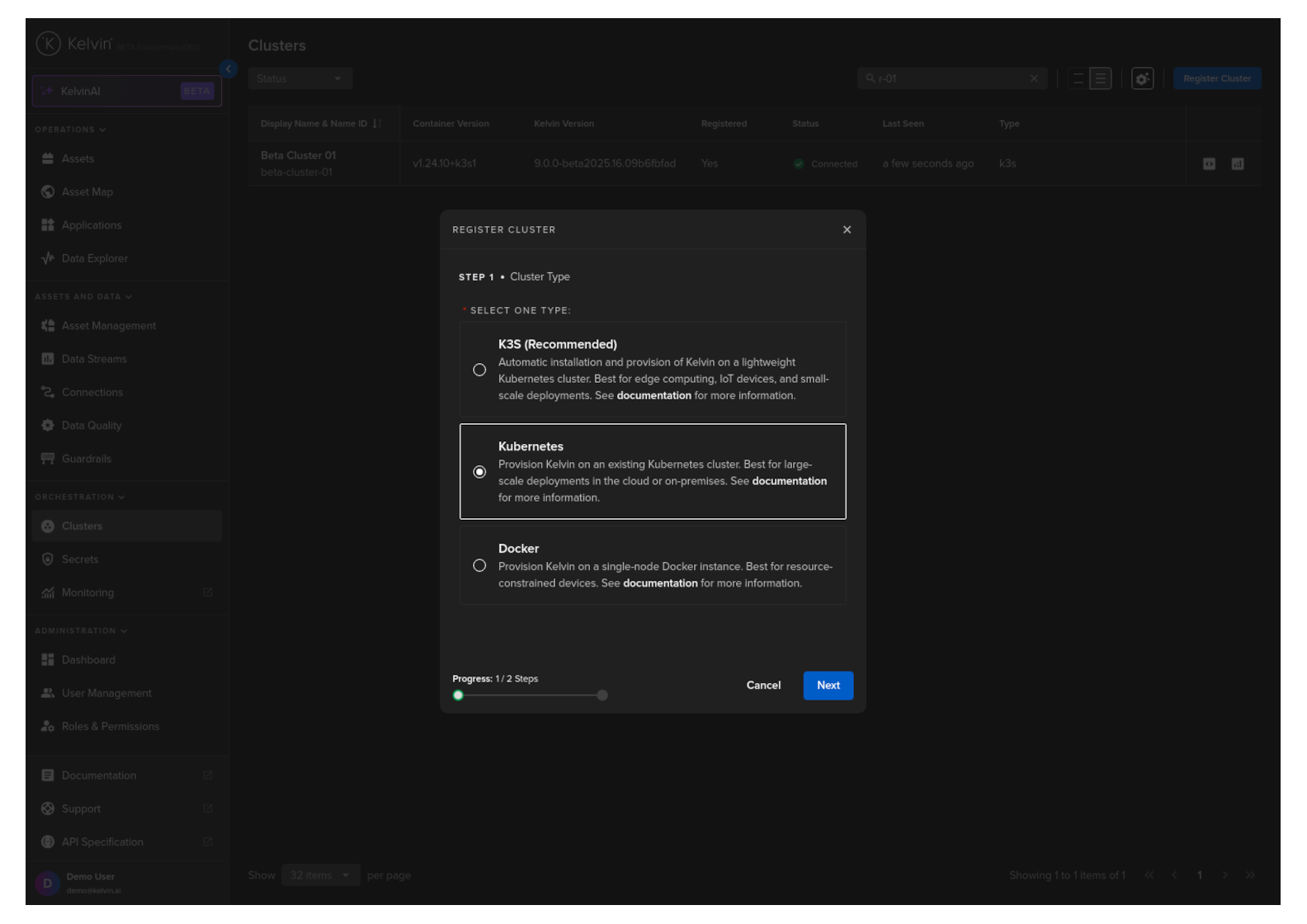
Then in the popup you will see three cluster options to choose from.
Note
Basic users who do not want to maintain their own Kubernetes clusters can choose K3S. In this case Kelvin will install and manage all aspects of the cluster.
Some versions of Kelvin only allow the basic Docker environment create option.
For this tutorial we will select the Kubernetes option.
Then click on the Next button.
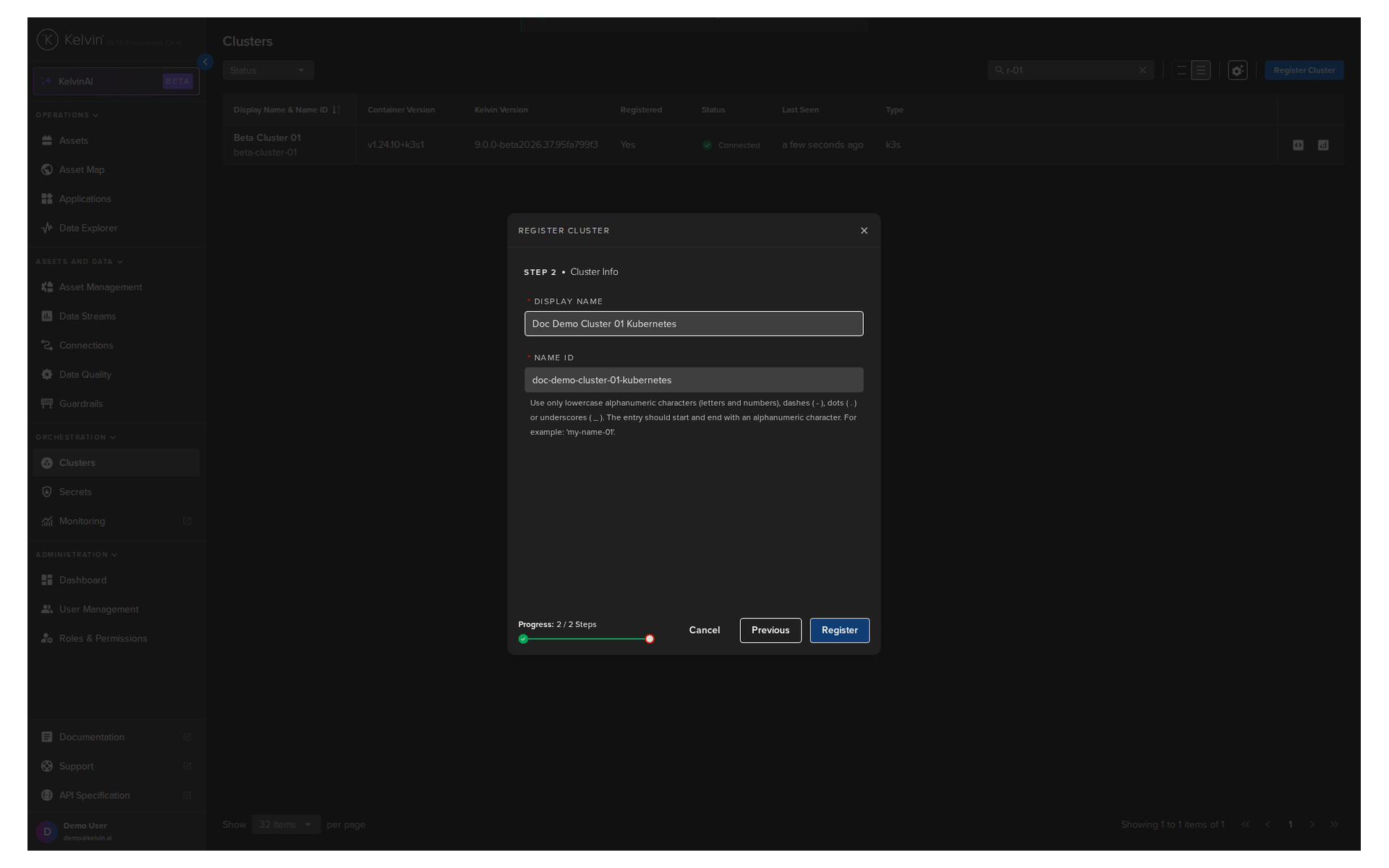
In step two, assign the new cluster a recognizable display name. The name id will be automatically created from your display name. It can usually be left unchanged.
Note
The Name ID will be created automatically when you create a Display Name. Normally this default name is satisfactory but you do have the option to customize it if you want.
| Option | Description |
|---|---|
| Display Name | This can be any characters and spaces that gives your cluster a memorable name for reference |
| Name ID | A unique lower-case alphanumeric name which uniquely identifies this cluster. This will be automatically filled in when you type the Display Name. Normally you do not need to change unless the Name ID clashes with another cluster's Name ID. |
The Name ID is the unique identifier name for the cluster. This must contain only lowercase alphanumeric characters. The ., _ and - characters are also allowed to separate words instead of a space BUT can not be at the beginning or end of the name.
Click Register.
You can then download the manifest YAML file and then run the CLI command in your AKS environment.
Make sure the manifest YAML file is locally accessible to the kubectl command.
Also you can see the sample kubectl command you will need to execute for your Cluster.
| Sample Commands to Install Kelvin Specific Pods on Kubernetes Cluster | |
|---|---|
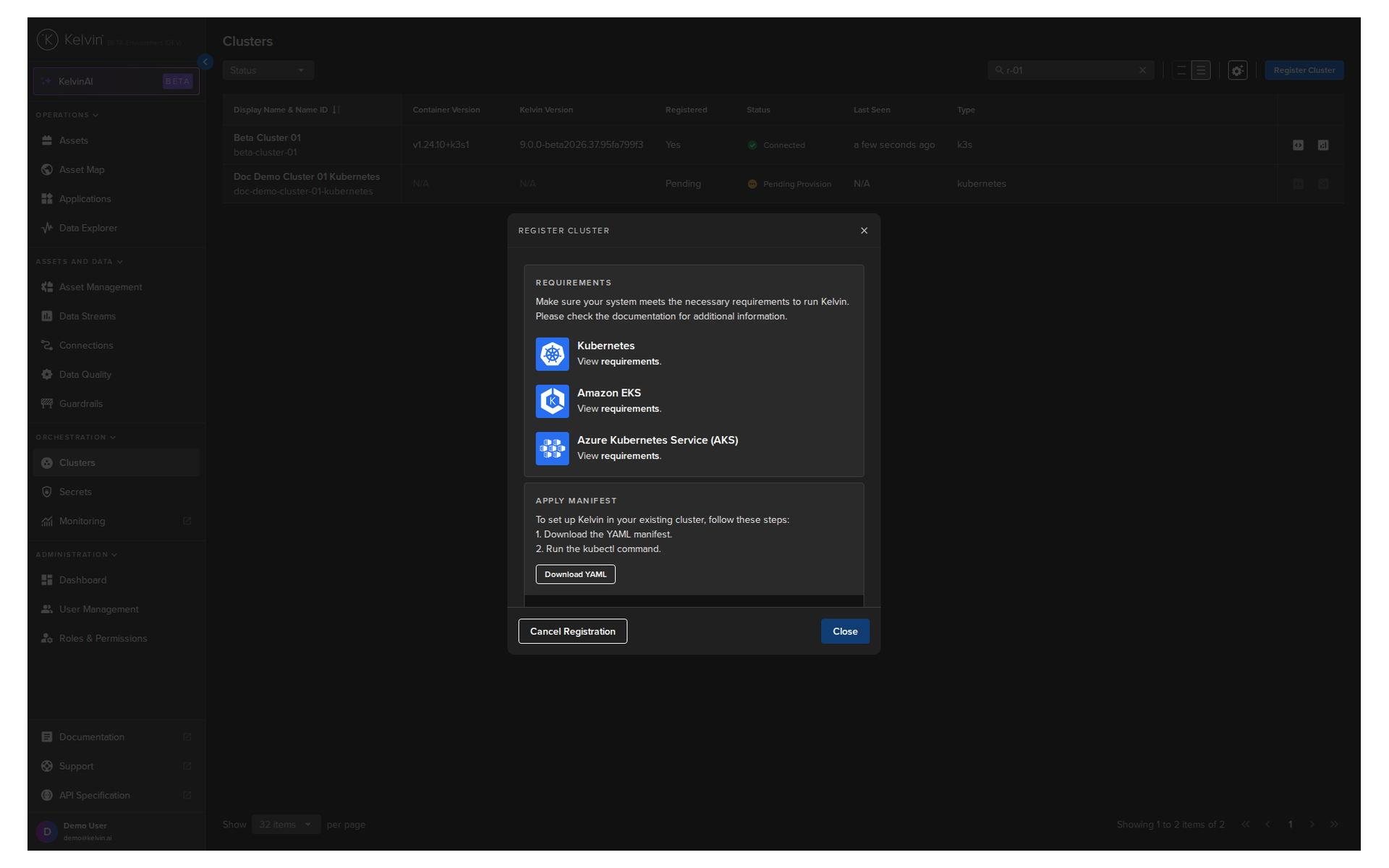
Next click the Close button. The cluster is now registered in the Cloud and you can see it is pending registration.
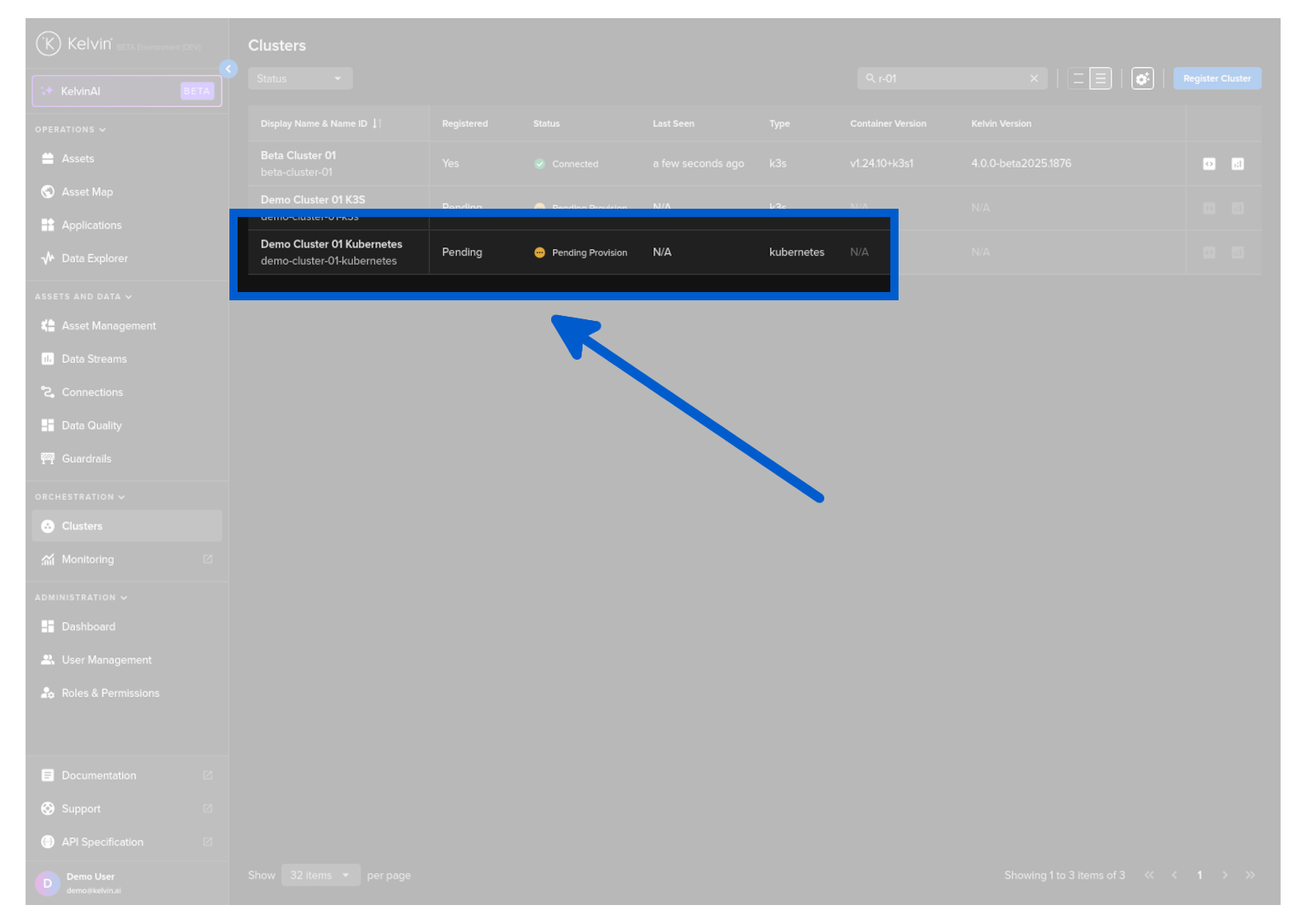
2. Install Kelvin specific pods on your Cluster
Run the command to execute the yaml file parameters into your Cluster.
Congratulations, after a few minutes depending on your Internet speed your new cluster is ready for use.
| Install Kelvin Specific Pods on Kubernetes Cluster | |
|---|---|
| API cURL Example | |
|---|---|
The response will look something like this;
You can then get the manifest YAML file that is mentioned in the provision script with the API request;
| API cURL Example | |
|---|---|
which will give a YAML response starting like this;
| API cURL Example Response | |
|---|---|
Copy and paste this into a file called kelvin.yaml and then run the CLI command given in the key provision_script in your AKS environment.
Make sure the manifest YAML file is locally accessible to the kubectl command.
The actual CLI command is;
| Install Kelvin Specific Pods on Kubernetes Cluster | |
|---|---|
Congratulations, after a few minutes depending on your Internet speed your new cluster is ready for use.
You can save the manifest YAML file that is mentioned in the provision script with;
| API Client (Python) Example | |
|---|---|
Make sure the manifest YAML file is locally accessible to the kubectl command.
And then run the CLI command given in the key provision_script in your AKS environment. The actual CLI command is;
| Install Kelvin Specific Pods on Kubernetes Cluster | |
|---|---|
Congratulations, after a few minutes depending on your Internet speed your new cluster is ready for use.