Create a Docker App
Create a Docker App
A Docker App is a standard docker container and is created and developed like any normal container for docker and Kuberenetes.
You can build for both x86_64 and arm64 devices.
At a minimum to be compatible with Kelvin, you need two files.
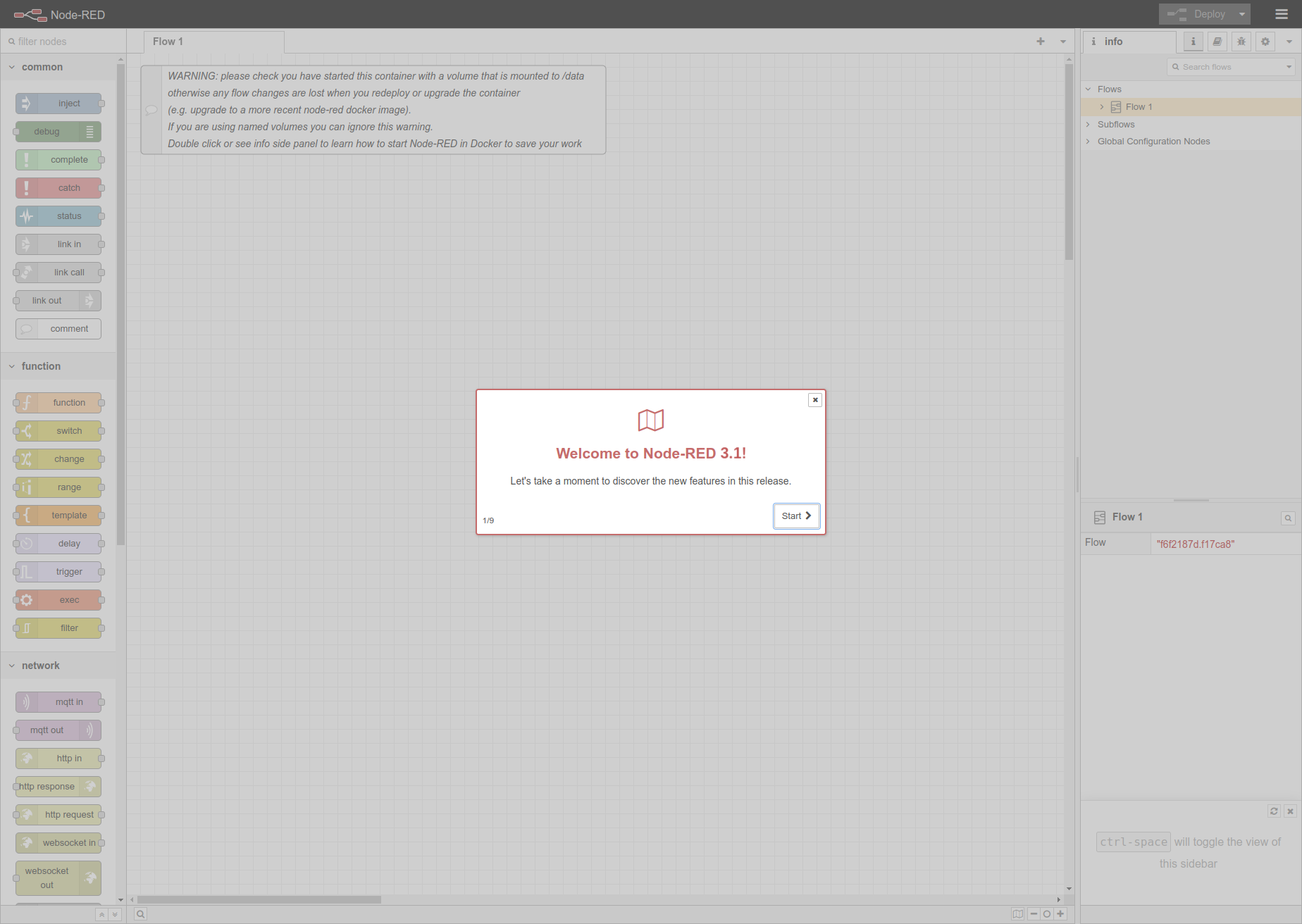
For this example we will get ready for deploying a stock Node Red Server to the edge which can then be accessed on the local LAN network at port 1880 in any modern broswer.
The app.yaml is the main configuration file that holds both Kelvin SmartApps™ definition as well as the deployment/runtime configuration.
For our example it would look like this;
| app.yaml Example | |
|---|---|
1 2 3 4 5 6 7 8 9 10 11 12 13 14 15 16 17 18 19 20 21 22 23 24 25 26 27 28 29 30 | |
It is composed by the following sections:
-
The
spec_versionsection is automatically injected and specifies Kelvin SmartApps™ JSON Schema(latest) version which both defines and validates theapp.yamlstructure.app.yaml Example 1spec_version: 5.0.0 -
The
typesection defines the type for the application.app: A Smart App that allows mapping inputs and outputs to data streams, sending control changes, recommendations, and data tags.docker: An docker application that does not connect to the platform's data streams.importer: Connects to an external system to import data into the platform as well as receive control changes to act on the external system.exporter: Connects to the platform to export data to an external system.
app.yaml Example 1type: docker -
The
infosection holds Docker App's basic information required to make itself uploadable to Kelvin's App Registry.app.yaml Example 1 2 3 4
description: Local Node Red Server Demo
name: local-node-red-server-demo
title: Local Node Red Server Demo
version: 1.0.0
The
nameis the Docker App's unique identifier.The
titleanddescriptionwill appear in App Registry on the Kelvin UI once the Docker App is uploaded.Info
The
versionshould be bumped every time Docker App gets an update, and before it gets uploaded to the App Registry.The upload will be rejected if there is the version already exists on the Kelvin Platform.
-
The
flagssection is where you are able to set some of the application capabilities.app.yaml Example 1 2 3 4 5
flags: enable_runtime_update: # enables configuration updates at runtime configuration: false -
The
ui_schemassection is where the Docker App configuration is defined for the Kelvin UI.The actual information is kept in a
jsonfile in the ui_schemas folder of the project. The file location is defined in theapp.yamlfile like this;app.yaml Example 1 2
ui_schemas:
configurations: "ui_schemas/configurations.json"
The json file will come with default blank schemas when first created.
Note
configurations.jsoninformation is optional, and if not provided, the Kelvin UI will display the configuration settings in a raw JSON or YAML file format without verifying the structure or content before applying them to the Kelvin SmartApp™.Default ui_schemas/configurations.json 1 2 3 4 5
{
    "type": "object",
    "properties": {},
    "required": []
}
An example of a App Configurations JSON file filled in would look something like this;
Sample ui_schemas/configurations.json 1 2 3 4 5 6 7 8 9 10 11 12 13 14 15 16 17 18 19 20 21 22 23 24 25 26
{ "type": "object", "properties": { "closed_loop": { "type": "boolean", "title": "Closed Loop" }, "speed_decrease_set_point": { "type": "number", "title": "Speed Decrease SetPoint", "minimum": 1000, "maximum": 3000 }, "temperature_max_threshold": { "type": "number", "title": "Temperature Max Threshold", "minimum": 50, "maximum": 100 } }, "required": [ "closed_loop", "speed_decrease_set_point", "temperature_max_threshold" ] } -
The
defaults/systemsection is [optional] and can be used to set different system requirements/constraints within the Docker App's running environment. i.e. Resources, Environment Variables, Volumes, Ports, etc:app.yaml Example 1 2 3 4 5 6 7
defaults: system: ports: [] resources: {} environment_vars: [] volumes: [] privileged: Boolean -
The
defaults\system\portsis where you can define ports to open on the container to the local network:app.yaml Example 1 2 3 4 5 6 7 8 9 10 11 12 13
defaults: system: ports: - name: http type: host host: port: 1880 - name: opcua type: service # Exposed as a service for other containers service: port: 48010 exposed_port: 30120 -
The
defaults\system\resourcesis where you want to limit resources a container can use. This defines the reserved (requests) andlimitsthe resources allocated to the Docker App:app.yaml Example 1 2 3 4 5 6 7 8 9
defaults: system: resources: requests: # Reserved cpu: 100m memory: 256Mi limits: # Limits cpu: 200m memory: 512Mi -
The
defaults\system\environment_varsis used to define Environment Variables available within the Docker App container. i.e.:app.yaml Example 1 2 3 4 5
defaults:
  system:
    environment_vars:
      - name: KELVIN_GW_MODE
        value: SOCKETS
Info
KELVIN_GW_MODEis an Environment Variable that is [required] by Kelvin's platform. Others can optionally be added. -
The
defaults\system\volumesis to share and persist data generated by Kelvin SmartApps™ or used by it in a specific place. They act like a shared folder between the Docker App and the host. Kelvin supports directory volumes, such as folders or serial ports, persistent, and file/test volumes:app.yaml Example 1 2 3 4 5 6 7 8 9 10 11 12 13 14 15 16 17 18 19 20 21 22 23 24
defaults: system: volumes: # Folder Volume - name: serial-rs232 target: /dev/rs232 # Container path type: host host: source: /dev/ttyS0 # Host path # Persistent Volume - name: extremedb target: /extremedb/data type: persistent # File/Text Volume - name: model-parameters target: /opt/kelvin/data/parameters.bin type: text # Renders data into a file text: base64: true encoding: utf-8 data: |- SGVsbG8gUHJvZHVjdCBHdWlsZCwgZnJvbSB0aGUgRW5naW5lZXJpbmcgR3VpbGQhCg== -
The
defaults\system\privilegedis [optional] and used to grant extended privileges to Kelvin SmartApps™, allowing it to access any devices on the host, such as a Serial device:app.yaml Example 1 2 3
defaults: system: privileged: false -
The
defaults\configurationare the default global Docker App configuration values.Note
Operations will have the option to change these at runtime from the Kelvin UI.
app.yaml Example 1 2 3 4
defaults:
  configuration:
    broker-ip: edge-mqtt-broker
    broker-port: 1883
The Dockerfile is a script used to define the instructions and configuration for building a Docker image. It specifies the base image, installation of software, file copying, and other setup tasks needed to create a reproducible and isolated environment for running Kelvin SmartApps™ in Docker containers.
For example if you wanted to create a basic Node Red Server for deployment to the edge, your Dockerfile can look something like this;
| Dockerfile Example | |
|---|---|
1 | |